

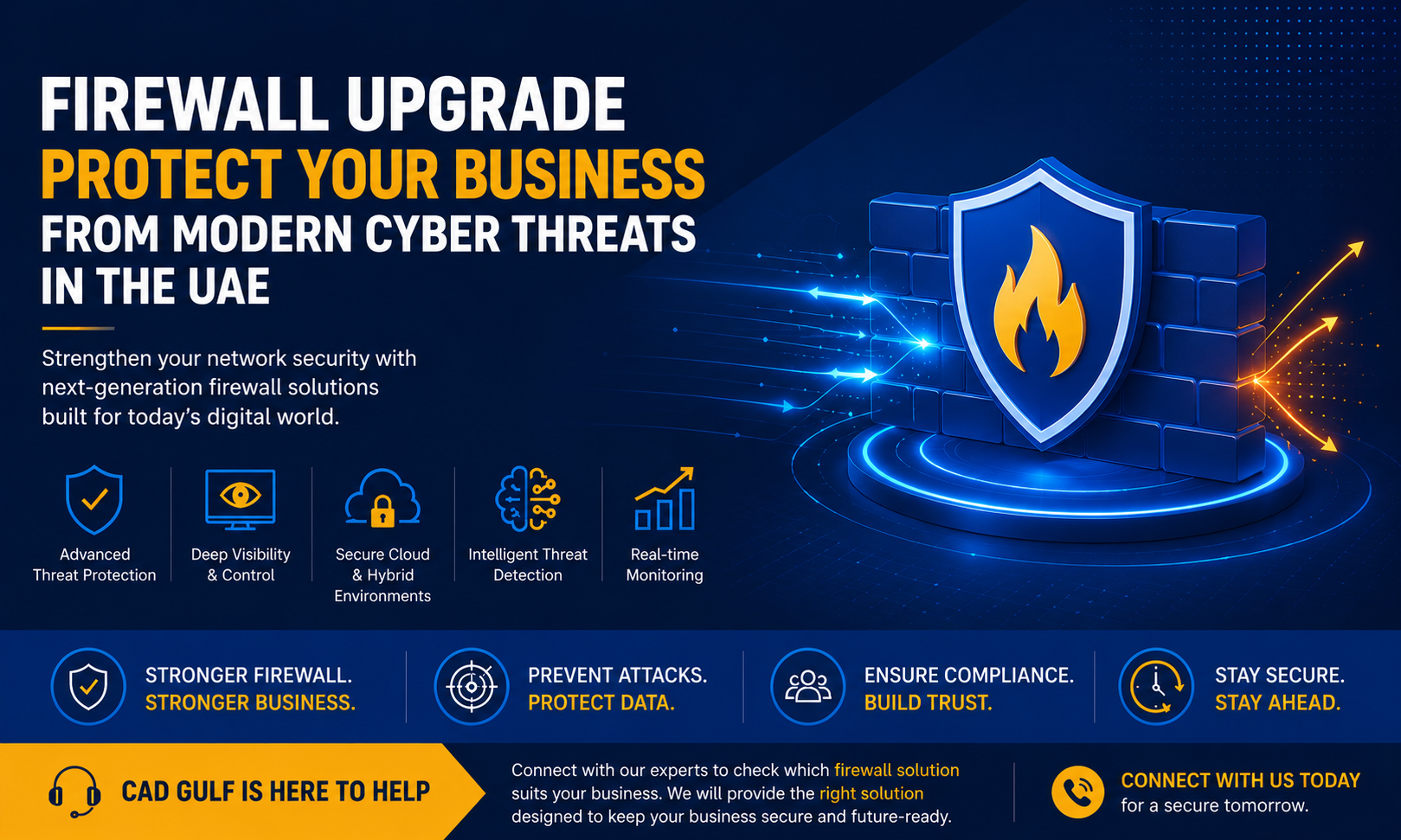
Cybersecurity is no longer just a global concern—it has become a critical business priority across the UAE. In recent years, the country has witnessed a sharp rise in sophisticated cyberattacks targeting government entities, financial institutions, infrastructure providers, and private organizations. From ransomware campaigns and AI-powered phishing attacks to large-scale DDoS incidents, the threat landscape is evolving faster than ever.
The UAE Cybersecurity Council recently confirmed that national systems successfully blocked organized cyberattacks aimed at critical digital infrastructure and vital sectors, including attempts involving ransomware, phishing, and AI-driven offensive tools. Reports also indicate that cyberattack attempts in the UAE have surged dramatically, with hundreds of thousands of attacks being detected daily against public and private organizations.
As businesses across the UAE continue accelerating digital transformation, adopting cloud platforms, enabling remote work, and integrating smart technologies, traditional security systems are struggling to keep pace with modern threats. Many legacy firewalls were designed for a simpler network environment and are no longer capable of effectively detecting encrypted threats, controlling cloud applications, or preventing advanced lateral attacks within modern infrastructures.
This is why upgrading to a next-generation firewall (NGFW) has become more than an IT upgrade—it is now a business-critical cybersecurity investment.
Modern firewalls provide intelligent threat detection, intrusion prevention, encrypted traffic inspection, application-level visibility, AI-powered analytics, and real-time monitoring capabilities that help organizations defend against increasingly sophisticated cyberattacks. They also play a vital role in protecting hybrid work environments, securing cloud workloads, supporting compliance requirements, and ensuring business continuity in a region where cyber threats continue to intensify.
In this blog, we explore how upgrading your firewall can help UAE businesses strengthen cybersecurity resilience, improve network visibility, reduce operational risks, and stay protected against the growing wave of modern cyber threats targeting the region.
What Is a Firewall and What Does It Do?
A firewall is a network security system that monitors and controls incoming and outgoing traffic based on pre-established rules. It serves as a barrier between a trusted internal network and untrusted external networks, such as the Internet.
Basic functions of a firewall include:
- Filtering network traffic
- Preventing unauthorized access
- Logging network activity
- Enforcing security policies
While traditional firewalls provide packet filtering and stateful inspection, modern businesses require more advanced capabilities to defend against complex threats.
The Growing Complexity of Cyber Threats
The threat landscape has evolved significantly. Attacks are now more targeted, faster, and often encrypted to avoid detection. Key trends include:
- Rise of ransomware-as-a-service (RaaS): Easy-to-use ransomware kits are available for purchase on the dark web.
- Encrypted attacks: More than 85% of internet traffic is encrypted, and many threats are hidden within.
- Multi-vector threats: Attackers use a combination of phishing, malware, and lateral movement inside networks.
- Remote work vulnerabilities: Employees working outside the corporate network introduce new risks.
Older firewall systems are not equipped to deal with these complexities.
Key Features of Next-Generation Firewalls (NGFWs)
Upgrading to a next-generation firewall (NGFW) offers enhanced protection through advanced features:
| Feature | Description |
|---|---|
| Application Awareness | Controls traffic based on applications, not just ports or protocols. |
| Intrusion Prevention System (IPS) | Detects and blocks known threats using updated signatures. |
| Deep Packet Inspection (DPI) | Examines the data part of network packets for hidden threats. |
| Encrypted Traffic Inspection | Decrypts and inspects HTTPS traffic for malicious content. |
| Advanced Threat Protection (ATP) | Uses AI and behavior analytics to detect zero-day threats. |
| Integration with Security Ecosystem | Works with endpoint protection, SIEM, and cloud services. |
These features are essential for protecting modern business environments with diverse endpoints, cloud workloads, and mobile users.
Business Benefits of Upgrading Your Firewall
A firewall upgrade is more than a security enhancement—it offers strategic business value:
1. Improved Threat Detection and Response
NGFWs identify threats faster and respond automatically, reducing the risk of data breaches.
2. Regulatory Compliance
Many standards like ISO 27001, GDPR, and UAE NESA require advanced network protection capabilities that legacy systems cannot provide.
3. Support for Cloud and Hybrid Environments
Modern firewalls support cloud-based applications, platforms like Microsoft 365, and SaaS integrations.
4. Enhanced Network Performance
Modern devices use smarter traffic handling and load balancing to avoid bottlenecks while maintaining security.
5. Reduced Operational Burden
Centralized management consoles and automation tools reduce the workload on IT teams.
When Should a Business Consider a Firewall Upgrade?
Here are some indicators that it may be time to upgrade:
- You’re running a firewall that’s 3–5+ years old
- Your team struggles with managing security rules manually
- You have adopted cloud services or a remote workforce
- Your firewall does not support SSL decryption
- You’re undergoing a digital transformation or IT infrastructure overhaul
- Compliance audits are becoming increasingly difficult
The Role of Firewalls in a Zero Trust Security Model
Many organizations are shifting toward Zero Trust Architecture, which assumes no user or device is trusted by default—even inside the corporate network.
Upgraded firewalls play a central role in this model by:
- Verifying identity and device health before granting access
- Segmenting networks to prevent lateral movement of threats
- Logging and analyzing all activity for anomalies
Firewall Deployment Models
Depending on your environment, firewalls can be deployed in various ways:
| Deployment Type | Description |
|---|---|
| Hardware Firewall | Physical devices installed at network perimeters |
| Virtual Firewall | Software-based, deployed on cloud or virtual environments |
| Cloud-native Firewall | Designed for public cloud platforms (e.g., Azure Firewall, AWS WAF) |
| Managed Firewall Services | Outsourced to a third-party vendor for monitoring and management |
Each model has its advantages and can be chosen based on business needs, scalability, and compliance requirements.
Final Thoughts
Cyber threats are becoming more advanced and frequent across the UAE, making strong network security a necessity for every business. Whether your organization operates on-premises, in the cloud, or within a hybrid environment, relying on outdated firewall systems can leave critical data and operations exposed to modern cyber risks.
Upgrading to a next-generation firewall helps businesses improve visibility, strengthen threat protection, secure remote access, and maintain better control over network activity. However, choosing the right firewall solution depends on several factors, including your business size, industry, infrastructure, compliance requirements, and future growth plans.
At CAD Gulf LLC, we help businesses across the UAE identify and implement the right firewall and cybersecurity solutions based on their specific operational needs. Our team works closely with organizations to evaluate their current security environment, understand potential risks, and recommend firewall technologies that deliver the right balance of performance, scalability, and protection.
If you are planning to upgrade your cybersecurity infrastructure or want to understand which firewall solution best fits your business environment, connect with CAD Gulf today. Our experts are here to help you build a secure, reliable, and future-ready network infrastructure designed to protect your business against evolving cyber threats.